Hiring a building demolition contractor in Lovell, WY starts with one question: what will the job actually cost? Pricing swings by thousands of dollars depending on building size, materials, and what's hiding behind the walls. This guide breaks down 2026 pricing, what a complete bid should include, and the local permit rules Big Horn County property owners run into before the first wall comes down.
How Much Does a Building Demolition Contractor Charge in Lovell, WY?
Commercial demolition pricing is driven almost entirely by square footage, building materials, and disposal logistics. As a national planning range, small commercial structures run $4 to $8 per square foot, while larger or more complex buildings climb well past $18 per square foot once size, structure type, and hauling distance are factored in.
| Building Size | Typical Cost per Sq Ft | Typical Total Project Cost |
|---|---|---|
| 1,000–5,000 sq ft (shop, standalone retail) | $4–$8 | $8,000–$40,000 |
| 5,000–10,000 sq ft (mid-size commercial) | $6–$12 | $30,000–$90,000 |
| 10,000–20,000 sq ft (warehouse, large retail) | $12–$18 | $120,000–$240,000 |
| 20,000+ sq ft (large commercial or industrial) | $18–$30 | $300,000 and up |
These are national reference ranges, not a Lovell-specific quote. Rural Wyoming projects often land toward the lower end of each tier since local labor and tipping fees run cheaper than metro markets, though remote sites can add some of that back in equipment mobilization. A demolition contractor's bill covers more than the teardown itself: the crew handles planning, safety protocols, equipment, hauling, and final grading, and all of that is baked into the per-square-foot number.
The only way to get an accurate figure for your building is a site visit and a written estimate. Get a free estimate once you have a sense of what's typical for your project size.
Real-World Demolition Cost Examples
A few reference points help you triangulate your own project:
- 1,200 sq ft standalone retail building: roughly $8,000–$15,000
- 4,500 sq ft single-story commercial building: roughly $35,000–$55,000
- 10,000 sq ft warehouse with concrete slab: roughly $60,000–$90,000 once foundation removal and hauling are included
What Drives Demolition Pricing Up or Down
Building size has the single biggest influence on a bid. Beyond square footage, a few variables move the number up or down:
- Hazardous materials. Asbestos, lead paint, and similar materials require testing, abatement, and specialized disposal, which adds real cost before the structure even comes down.
- Foundation type. A building with a basement or deep foundation costs more to clear than a simple slab-on-grade structure, since breaking up and hauling concrete adds labor hours and dump weight.
- Site access. Tight lots, nearby structures, or limited equipment access slow the job and raise labor time.
- Disposal distance. In Big Horn County, debris typically goes to the North Big Horn County Landfill, located a few miles outside Lovell off Highway 310, which accepts construction and demolition waste locally rather than requiring a long haul to a metro facility.
Always confirm exactly what's in a bid. Permits, utility disconnections, foundation removal, debris hauling, and hazardous material handling are the line items most often missing from a low bid, and they're the top cause of surprise charges once work starts. Federal rules also require specific testing and notification steps before most commercial buildings can come down.
What Should a Demolition Quote Include?
A complete estimate spells out every stage of the job, not just the teardown. Use this checklist when reviewing a bid from any Lovell-area contractor:
- Permits and inspections — confirm who pulls them and who pays the fees
- Utility disconnections — gas, water, electric, and sewer capped before work begins
- Foundation or basement removal — priced separately, often per cubic yard
- Debris hauling and disposal — including landfill or recycling fees
- Site cleanup and grading — leaving the lot level and ready for its next use
- Hazardous material handling — testing, abatement, and disposal if applicable
If any of these items is missing from a written bid, ask why before signing. Contact our team for a full written estimate that spells out every line item up front.
How to Choose the Right Demolition Contractor
Demolition carries real safety and health risks, so the contractor you hire has to follow strict codes on-site, not just show up with an excavator. Get multiple quotes, then use the three checks below to judge who's actually qualified.
Hazardous Material Testing and Removal
Federal rules under the Clean Air Act's Asbestos NESHAP require a thorough asbestos inspection before most commercial demolitions, and notification is required even when no asbestos is found on site. Skipping this step isn't just risky, it can trigger fines and work stoppages. Review the EPA's overview of the Asbestos NESHAP program before scheduling any teardown, and ask your contractor directly how they handle testing.
Demolition work is also governed by OSHA's construction standards, which require a written engineering survey of the structure before crews start tearing it down. The OSHA Subpart T demolition standards cover preparatory surveys, utility shutoffs, and how walls and floors must come down in sequence.
Waste Disposal and Recycling
Every demolition project generates concrete, wood, metal, and dirt that has to leave the site before the job is finished. A reliable contractor separates materials for recycling where possible, which can lower disposal costs, and takes responsibility for clearing all of it, not just the visible pile out front. Ask for a real disposal plan, not just a general promise to "haul it away."
Licensing and Insurance in Wyoming
Wyoming doesn't issue a statewide general contractor license; licensing and permitting happen at the city and county level instead. In practice, that means confirming your contractor meets whatever local permit requirements apply in Lovell, plus carrying real liability insurance and, if they have employees, workers' compensation coverage. A fully insured company should have experience with projects similar in size and type to yours, with proof available on request. A contractor who hesitates to produce insurance paperwork is a red flag worth taking seriously.
Local Permitting and Site Considerations in Lovell, WY
Permitting works differently depending on whether your building sits inside Lovell town limits or out in rural Big Horn County, and this trips people up more than any other part of the process.
Inside Lovell: building permits are handled directly by Town Hall and can't be applied for online, so plan on an in-person or phone application before scheduling your crew.
Rural Big Horn County: the county doesn't enforce building codes on rural property, but a Development Permit Application still has to go through the Land Planning Department before work starts, partly to check whether the site falls inside a mapped floodplain.
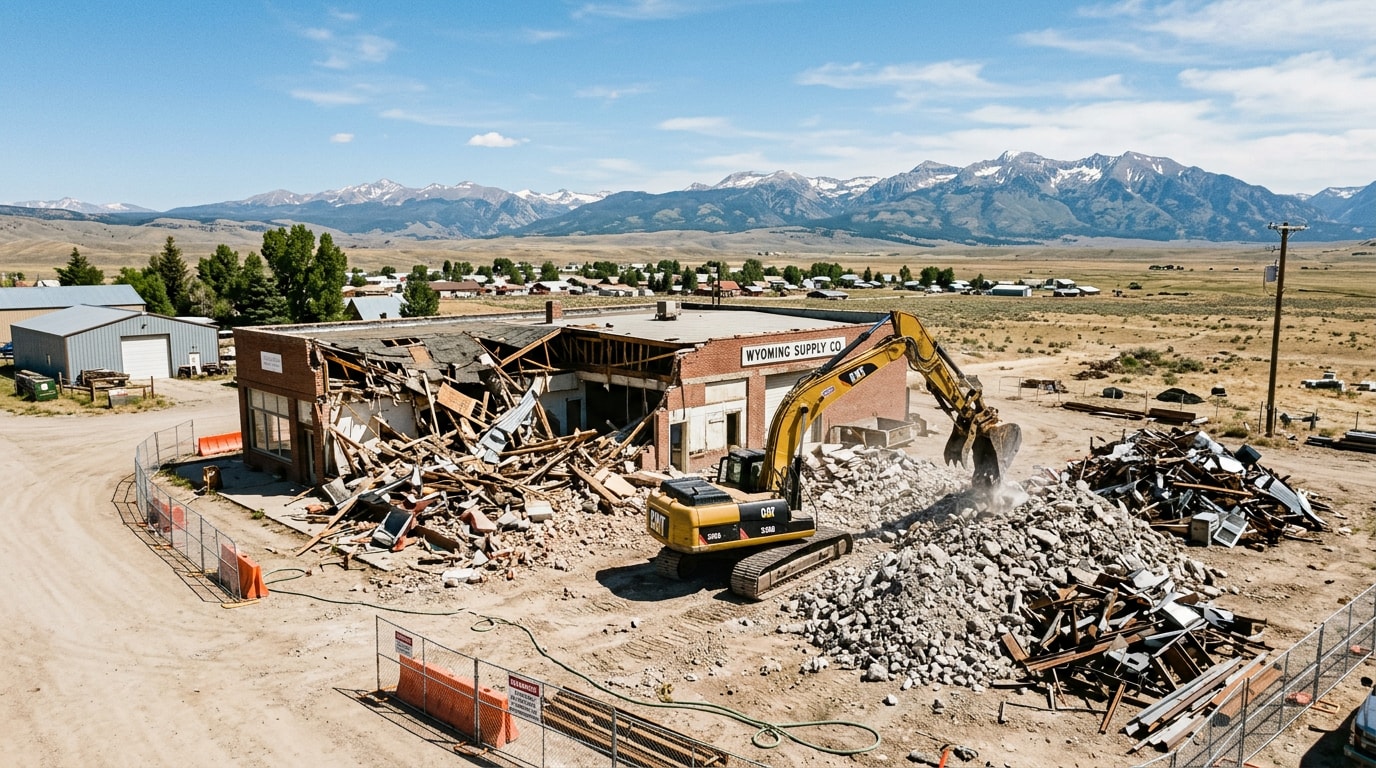
Lovell has direct experience with large-scale teardowns, too. In 2012, crews cleared the former North Big Horn Hospital, a building that had dominated half a city block for decades, down to a graded lot ready for redevelopment, with materials carefully separated for recycling along the way. It's a useful local reminder that even big, decades-old commercial buildings come down cleanly when the crew plans the sequence instead of just swinging equipment at the walls.
Our crews approach demolition and site prep the same way across Big Horn County and the surrounding region, whether that's clearing a single outbuilding or prepping a commercial lot for a ground-up rebuild. If your project moves straight into new construction afterward, our site preparation) and general contractor) teams can carry the project from teardown to finished grade without bringing in a second company.
Important Questions to Ask a Demolition Contractor
Group your questions into three buckets before you call anyone:
Legal and credentials: Do you have a business license? Is your crew trained and experienced with this type of structure? Have you handled a project this size before?
Scope and cost: Does your company carry liability insurance? Will you run an asbestos inspection before bidding? What's the estimated cost, and what's excluded?
Logistics: Do you have references from similar jobs? Is cleanup and grading included in the quote? What's your cancellation policy?
A red-flag answer to "will you run an asbestos inspection" sounds like "we don't usually bother unless the building looks old." A solid contractor explains that testing is standard practice on every project, regardless of the building's apparent age, since federal notification rules apply either way. That one answer tells you more about a contractor's standards than their price sheet does.
See examples of completed site work in our project gallery, or get a free estimate for your specific building. If your next step after demolition is new construction, our guide to framer construction costs and permits in nearby Worland, WY is a useful next read, and our Lovell, WY service area page has more on how we support projects across the region. You can also start from our homepage to see our full range of construction services.
FAQ
How much does commercial building demolition cost in Lovell, WY?
Small commercial buildings (1,000–5,000 sq ft) typically run $4 to $8 per square foot nationally, with rural Wyoming projects often trending toward the lower end. Larger buildings, basements, and hazardous materials all push the price higher. A site visit is the only way to get an exact number.
Do I need a permit to demolish a building in Lovell, WY?
Yes, if the building is inside Lovell town limits, you'll need a permit from Town Hall, applied for in person or by phone. In rural Big Horn County, a Development Permit Application goes through the county's Land Planning Department, partly to check for floodplain restrictions, even though the county doesn't enforce building codes on rural property.
How long does a building demolition take?
A small commercial building can come down in under a week once permits are secured. Larger or more complex structures, especially those with asbestos or deep foundations, can take several weeks from permitting through final grading. Permitting and hazardous material testing usually take longer than the physical teardown itself.
Is asbestos testing required before demolition?
Yes. Under the EPA's Asbestos NESHAP rule, a thorough inspection and advance notification are required before most commercial demolitions, even if the building turns out to have no asbestos present. Skipping this step can result in fines and stop-work orders.
Does Wyoming require a license for demolition contractors?
Wyoming doesn't issue a statewide general contractor license. Licensing and permitting requirements are set locally by cities and counties, so what's required in Lovell can differ from what's required in Cody or Sheridan. Confirming local compliance and insurance coverage matters more than a single statewide credential.