A design build contractor holds one contract covering both the design and construction of your project, instead of the usual hand-off between a separate architect and builder. That single point of responsibility changes who answers your calls, who owns a mistake, and how fast the job actually moves. Here's what the model means in practice, and how to vet a firm before you sign anything.
What Is a Design-Build Contractor?
A design-build contractor is a single firm that designs and builds under one contract, from the first sketch through the final walkthrough.
In a traditional setup, the owner often relays information between the designer and the builder. With design-build, that go-between role disappears because one team absorbs it.
Design-build firms generally organize one of two ways:
- Contractor-led: design staff or consultants work under the construction company.
- Architect-led: a design firm brings construction in-house or partners closely with a builder.
Both structures can work well. The Design-Build Institute of America takes the position that design-build can be led by a contractor, a designer, a developer or a joint venture, as long as a design-build entity holds a single contract for both design and construction. One team, one contract, one party accountable for the result.
We've run design-build projects across the Bighorn Basin, from Powell to Cody to Sheridan, and the jobs that go smoothest are almost always the ones where design and pricing happen in the same room instead of across two separate companies. You can see how that plays out on our general contractor services page.
How the Design-Build Process Works
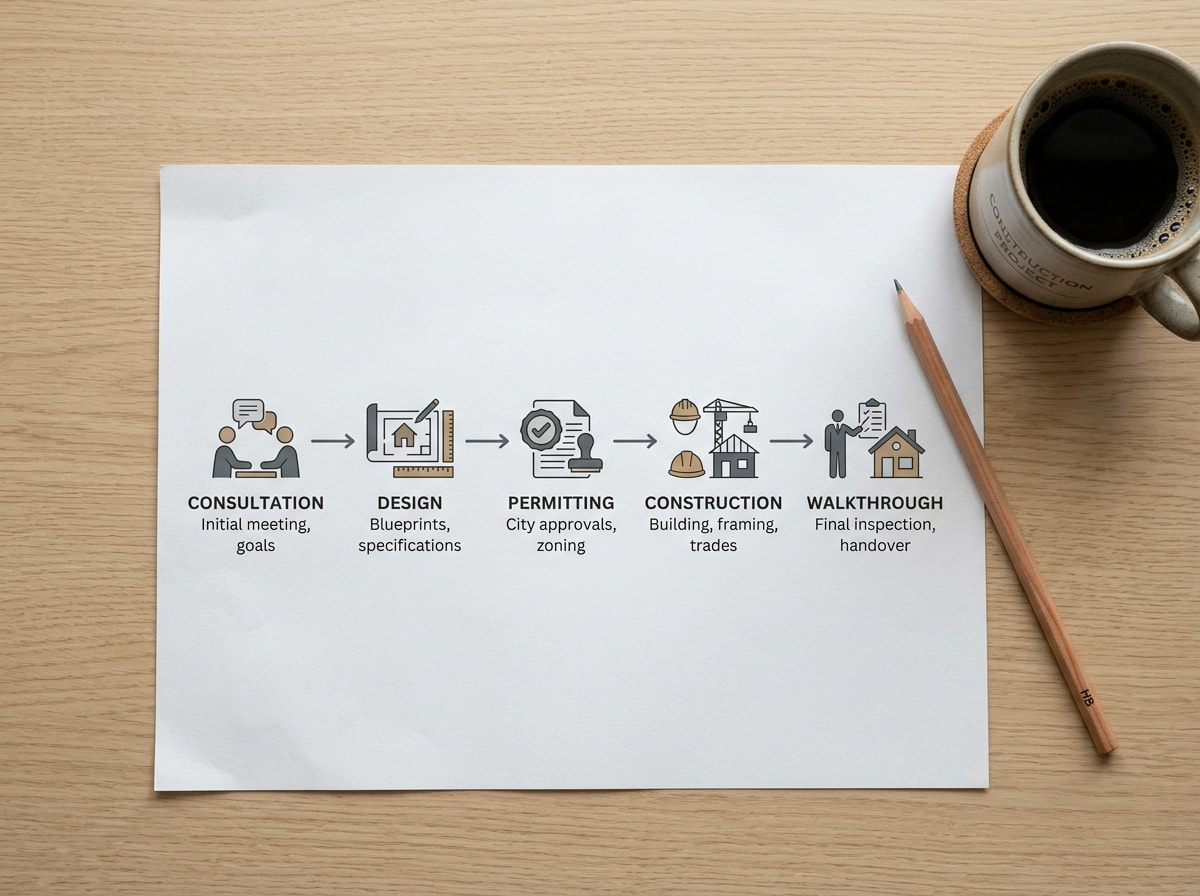
The process usually moves through the same rough sequence, whether it's a home addition or a commercial build-out.
- Initial consultation. The contractor learns your goals, budget range, and site conditions.
- Concept design. The team sketches layouts and material options before anything is locked in.
- Overlapping design and pricing. Permitting prep and cost conversations often start while design details are still being refined, rather than waiting for a fully stamped drawing set.
- Construction. The same team that designed the project builds it, so mid-construction questions get answered faster because there's no hand-off to chase down.
- Final walkthrough and punch list. The project closes with one team accountable for the finished product.
That overlap between steps 2 and 3 is the real time-saving mechanic of design-build. Construction planning and design development happen in parallel instead of in strict sequence. For additions and remodels specifically, this is also where our residential remodeling services and new construction services fit into the same workflow.
Design-Build vs. Design-Bid-Build
In a traditional design-bid-build project, the owner hires an architect to finish the design, then separately solicits bids from contractors to build it. That's two contracts, two teams, and the owner in the middle whenever a question comes up between them.
Owners interested in single-point responsibility for both design and construction can use the design/build delivery system instead, which is the core difference between the two models.
| Factor | Design-Build | Design-Bid-Build |
|---|---|---|
| Contracts | One contract, one firm | Separate contracts for designer and builder |
| Schedule | Design and construction phases overlap | Design must finish before bidding starts |
| Risk holder | Design-build firm carries integrated risk | Owner absorbs gaps between design and bid |
| Points of contact | Single team | Architect and contractor, separately |
| Change-order exposure | Lower, due to fewer hand-offs | Higher, due to design-to-build gaps |
The schedule difference isn't just a sales claim. Research on selecting project delivery systems by Victor Sanvido and Mark Konchar of Pennsylvania State University found that design-build projects are delivered 33.5% faster than projects that are designed and built under separate contracts. The same research is cited directly in the Federal Highway Administration's Design-Build Effectiveness Study, which also tracked lower unit costs on design-build projects.
Pros and Cons of a Design-Build Contractor
Advantages:
- Single accountability, no finger-pointing between designer and builder
- Typically faster schedule, since design and construction phases overlap
- Earlier visibility into likely costs, before committing to full construction
Trade-offs:
- You skip competitive bidding between multiple contractors, which some owners see as giving up a built-in cost check
- You're trusting one company's judgment instead of having an independent architect advocate solely for your interests
Neither list is a dealbreaker on its own. They're just worth naming before you sign a contract.
Why Owners Choose Design-Build
Most owners land on design-build for one of these reasons:
- Accountability. There's no finger-pointing between designer and builder when something goes wrong, because it's the same team.
- Communication. Decisions happen inside one organization instead of across two.
- Budget predictability. Pricing conversations start earlier, so you get a realistic sense of total cost before locking in a direction.
- Fewer disputes. When the people drawing the plans are the same people pricing and building them, there's less incentive to blame design choices for cost overruns.
This combination matters most on remodeling work, where scope tends to shift once walls open up and surprises surface. If you're weighing a remodel against new construction, our guide on how to find and hire the right remodeling contractors covers the vetting side in more depth. Ready to talk through your own project? Get a free estimate and we'll walk you through it.
How to Choose the Right Design-Build Contractor
Start by looking past the lowest bid.
- Check licensing, insurance, and bonding.
Check with your state or county government to confirm a contractor's license, and ask the contractor for proof of insurance.
- Ask whether design work happens with an in-house design team or gets routed to outside consultants. That affects coordination speed.
- Evaluate process and communication style, not just price. It tends to predict satisfaction better than quotes alone.
- Confirm how long the firm has actually operated in your area, not just nationally.
Review Their Portfolio and Experience
A firm's past work tells you more than its sales pitch. Look for projects similar in scope to yours. A kitchen remodel specialist isn't necessarily the right fit for a full home addition or a commercial build.
Pay attention to craftsmanship details in photos: trim work, tile lines, finish consistency. Then combine that with direct references from past clients. You can browse completed work on our project gallery before you request a consultation.
A Regional Factor Worth Flagging
If you're building in Wyoming or Montana, design-build has a practical edge that doesn't show up in national guides: a short construction season. Design and permitting can run through the winter months while frost-sensitive site work and foundations wait for the ground to cooperate, so the crew isn't starting from zero once the weather breaks. That overlap matters more here than in a market with a year-round build season.
Understanding Design-Build Costs and Timelines
Whether design-build costs more or less than hiring separately depends on the project. There's no universal rule that one delivery method always wins on price.
What holds up more consistently is budget predictability. Owners usually know where costs stand earlier in the process, because pricing conversations happen alongside design instead of after it's finalized.
Common Pricing Structures
| Structure | How it works |
|---|---|
| Lump-sum contract | One fixed total price for the whole project |
| Guaranteed Maximum Price (GMP) | A cost ceiling is set, with savings sometimes shared back to the owner |
Either structure can work, depending on how much design flexibility you want to preserve. On larger commercial or multi-phase jobs, this is also where dedicated project management services and commercial construction services start to matter, since someone needs to track budget against design changes in real time.
For baseline contract protections to look for regardless of delivery method, including written estimates and your right to cancel certain contracts within three business days, the FTC's consumer guidance on hiring a contractor is a useful reference point before you sign anything.
Learn more about how our team approaches these projects on the Red Rock Constructions homepage, or get a free estimate to start the conversation.
FAQ
What's the real difference between a design-build firm and a general contractor?
A general contractor typically steps in once plans already exist and builds from drawings someone else created. A design-build firm is involved from the first sketch, so design and construction decisions happen together instead of in separate, sequential stages.
Do I need architectural plans before hiring a design-build contractor?
No. The firm develops plans as part of the single contract. Design is built into the process, not a prerequisite for it. The American Institute of Architects' primer on project delivery methods outlines how design/build compares to design/bid/build if you want the formal breakdown.
How is pricing structured in a design-build contract?
Two structures are common. A lump-sum contract sets one fixed total price. A Guaranteed Maximum Price (GMP) sets a cost ceiling, with savings sometimes shared back with the owner. Either can work depending on how much design flexibility you want to keep.
Is design-build more expensive than hiring an architect and contractor separately?
Not necessarily. Total cost depends on the project, but design-build generally gives you a clearer cost picture earlier, since pricing and design happen together instead of after bids come in.
How long does the design-build process take?
It varies by scope, but the overlap between design and construction planning is what shortens the overall timeline compared to design-bid-build, where design has to fully finish before bidding even starts.
Can a design-build contractor also serve as an owner's representative?
Not in the traditional sense. A design-build contractor holds the actual design and construction contract and carries direct accountability for project deliverables. An owner's representative typically advocates for the owner without holding that contractual responsibility.